
Key Takeaways
- Value-driven shopping is rising, with UK consumers increasingly turning to affordable brands and resale platforms.
- British shoppers are highly cautious about AI in fashion making purchase decisions on their behalf.
- The UK remains a brand-first market, where shoppers typically start their journey directly on trusted brand websites, apps, or physical stores.
- Secondhand fashion and visual commerce present growth opportunities, while ultra-fast delivery (q-commerce) currently shows limited appeal.
Even with inflation falling to 3% in January 2026, shoppers are still feeling the strain of the cost of living crisis. Price is increasingly shaping not just what people buy, but how they shop.
More consumers are starting their journeys with value in mind – from turning to resale platforms like Vinted to gravitating toward affordable high-street names. Over the past quarter, Primark, Vinted, and Next recorded the strongest growth in share of brand search, reflecting a wider shift toward perceived value and smarter spending.
The economic climate continues to influence habits, making UK consumers more selective than ever. In 2026, British shoppers aren’t looking for louder campaigns or cutting-edge tech – they want shopping experiences that feel trustworthy and genuinely human.
How can your brand adapt and win over the hyper-selective British shopper?
Here are the key trends shaping the UK enterprise fashion retail landscape – and what they mean for the year ahead.
UK shoppers resist AI in fashion
Generative and agentic AI are the hottest trends of the decade, but in the UK, shoppers are deeply cautious about their roles in fashion. Across all global surveys, British shoppers are consistently the least trusting of AI.
Nearly half (48%) of UK consumers say they won’t use AI to shop for clothing at all – the highest rejection rate of any market surveyed.
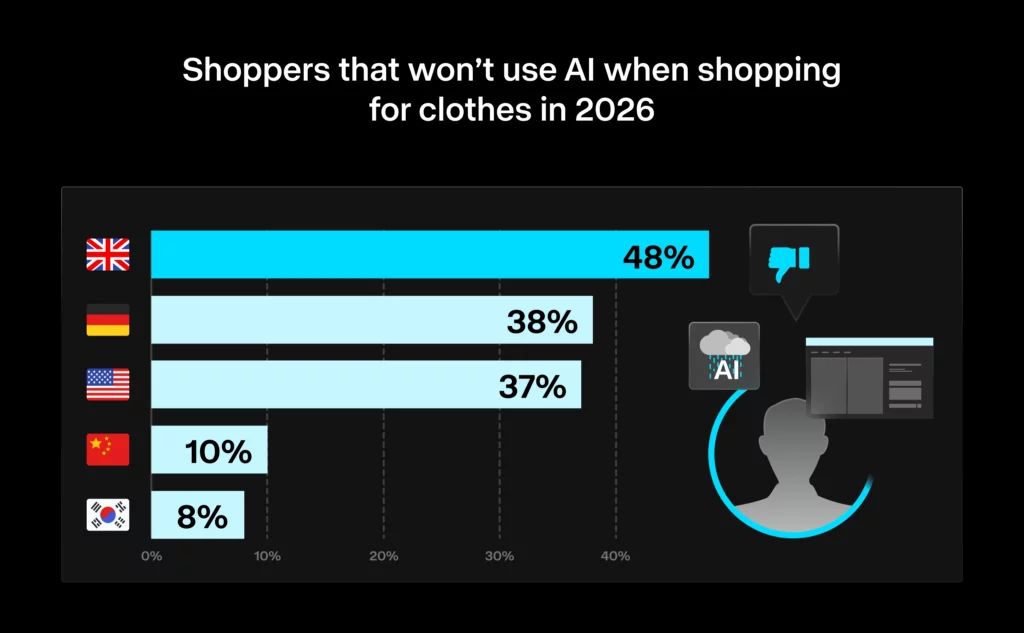
Similarly, when asked about agentic AI, 51% of these shoppers said they would be very unlikely to trust an agentic shopping assistant to make fashion purchases on their behalf.
The other half of shoppers that are open to AI have clear expectations – they want it to support them in their shopping journeys, not replace them. Today, AI is most welcome when it helps with tasks like price comparison, where 23% of shoppers say they see its value, and product discovery, noted by 17% of survey respondents.
But when AI begins to act independently, trust quickly lowers. UK shoppers’ concerns around agentic AI include:
- An AI agent won’t understand personal style
- Lost control over spending
- Skepticism around sponsored or biased recommendations
- Personal data privacy concerns
These concerns show that their resistance to AI in fashion isn’t about lack of awareness – it’s about agency and transparency.
In the UK, AI needs to feel optional. For retailers, the key to winning over shoppers in this market is to allow them to opt in and out of AI features. Ensure they see it as a helpful addition – not an essential part of the shopping experience.
See how the UK market compares to the rest of the world. Get the data in the guide, Fashion Retail 2026: Strategies for Winning in a World of AI, Algorithms, and Tariffs.
UK shoppers are brand loyalists
British shoppers stick to the basics when it comes to their online shopping journey. Even with the rise of online marketplaces, in 2026, the UK remains a brand-first fashion market, presenting retailers that earn consumer trust a major opportunity.
When UK shoppers begin their fashion journey, they’re most likely to start with brands’ platforms, like apps or websites. They also still value in-person shopping with 24% visiting brick-and-mortar stores.
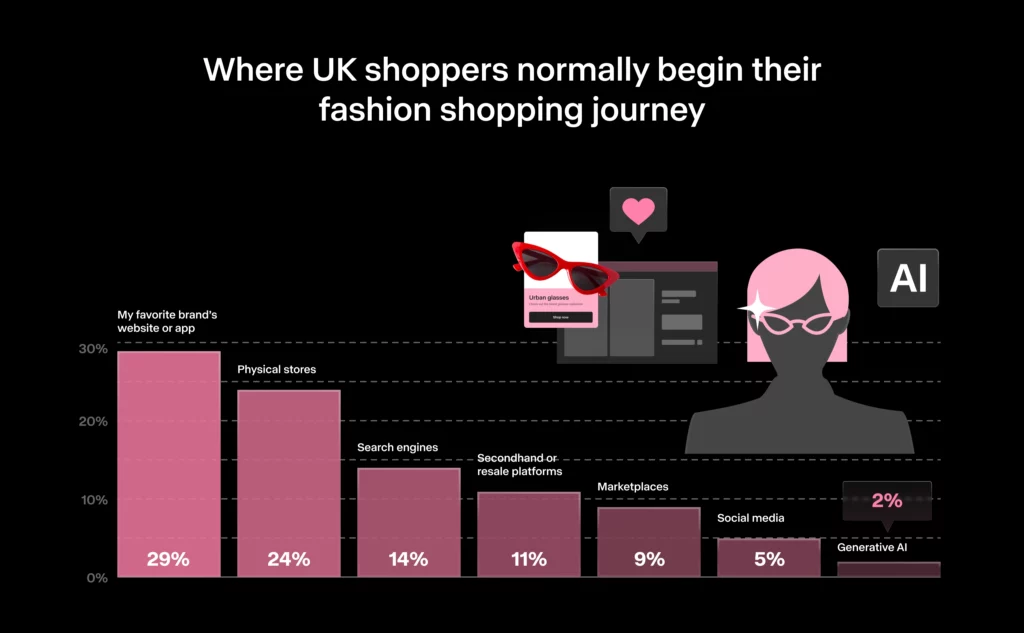
Unlike, in Asian and European regions, marketplaces play a surprisingly small role in early discovery. This shows that in the UK, your brands’ direct relationship to shoppers carries real power. When shoppers are ready to make a purchase, they head straight to the brands they trust – not the competition. So, in a market shaped by loyalty and long-term brand affinity, owning the first touchpoint can define the entire relationship.
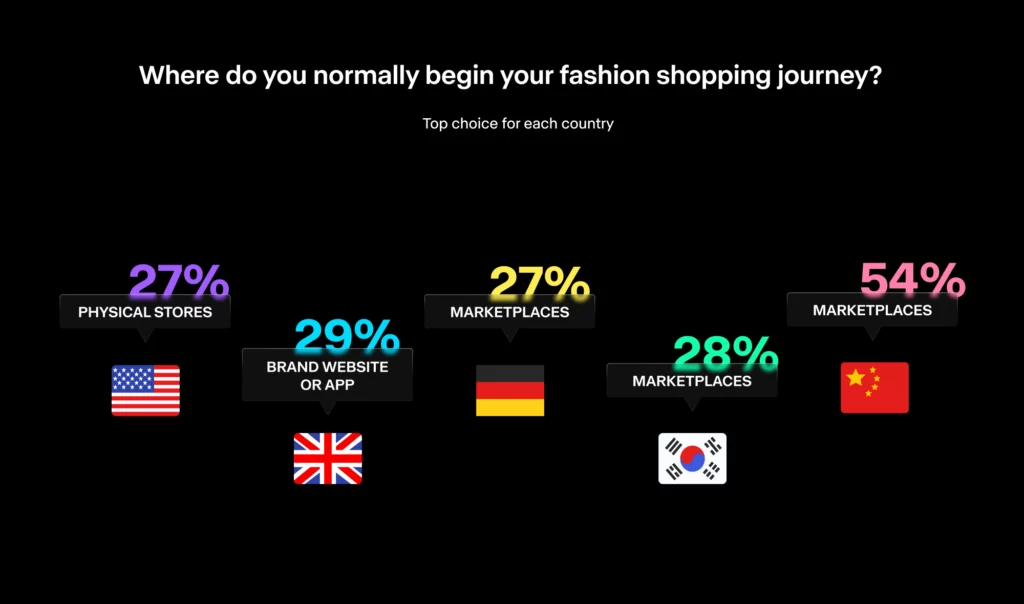
For enterprise fashion retailers, this means the brands winning – and retaining – customers in 2026 will be the ones focusing efforts on optimizing brand-led entry points. From discovery to delivery, every interaction should feel intentional, connected, and uniquely yours.
Secondhand fashion is becoming first choice
As affordability takes on a bigger role in how British shoppers discover fashion, resale is making its way to the mainstream. As budgets for clothes decrease, more consumers are valuing secondhand platforms as essential parts of their shopping journey.
When asked where shoppers normally begin their shopping journey, 11% of British respondents said secondhand or resale platforms. Although that number may not seem so striking, the UK led the trend amongst their global counterparts. And just because they’re not starting platforms like Vinted and Depop doesn’t mean they aren’t a stop along the way.
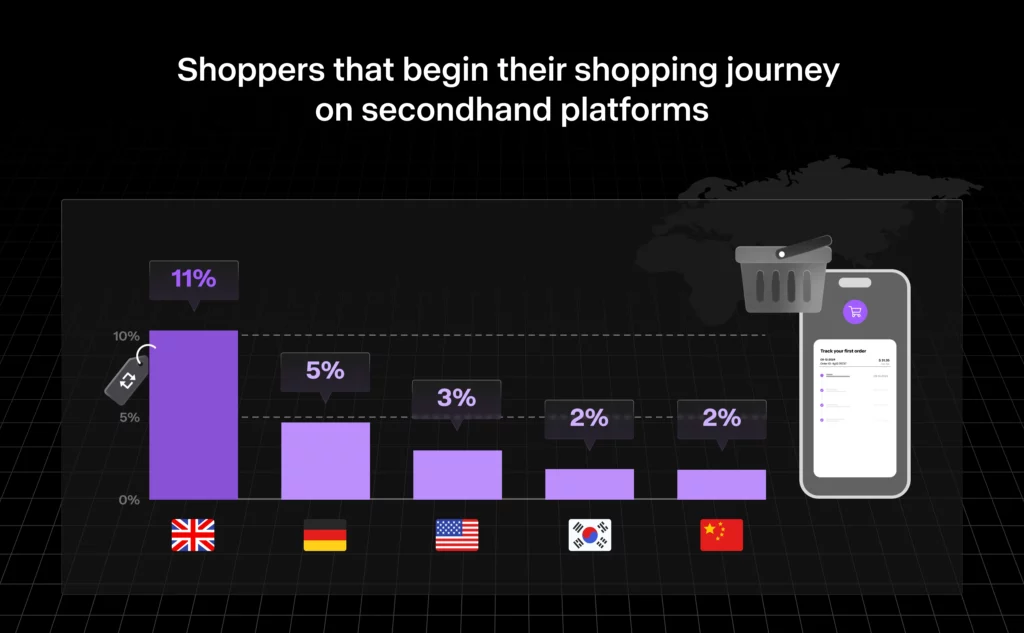
This shift doesn’t mean shoppers are turning away from their favorite brands – it means they’re redefining how they engage with them. The rise of secondhand sites reflects a growing preference for accessible fashion. For UK consumers, resale fits into their culture that’s already shaped by long-term brand loyalty – they’re still looking for the brands they love, just a price point that feels smarter.
Shoppers are still buying branded products, just not always from brand-owned channels. So, to stay relevant, think beyond the first sale and more towards the full story, like retail giant River Island’s. Its Take Back Scheme gives customers’ old clothes a new home. Shoppers can simply drop off old clothes at their store locations or organize a courier pickup to resell or recycle them. And in return, shoppers receive a £5 River Island voucher – a win-win for everyone.
Whether it’s through buybacks, a resale program, or pre-loved collections, the brands that become part of the secondhand fashion ecosystem will be the ones British shoppers trust in 2026.
Visual commerce holds untapped potential
From augmented reality (AR) try-ons and 3D product views, enterprise fashion retailers have more tools than ever to showcase products realistically. And brands like Zalando are already proving that engaging, dynamic visuals boost consumer confidence and lower return rates.
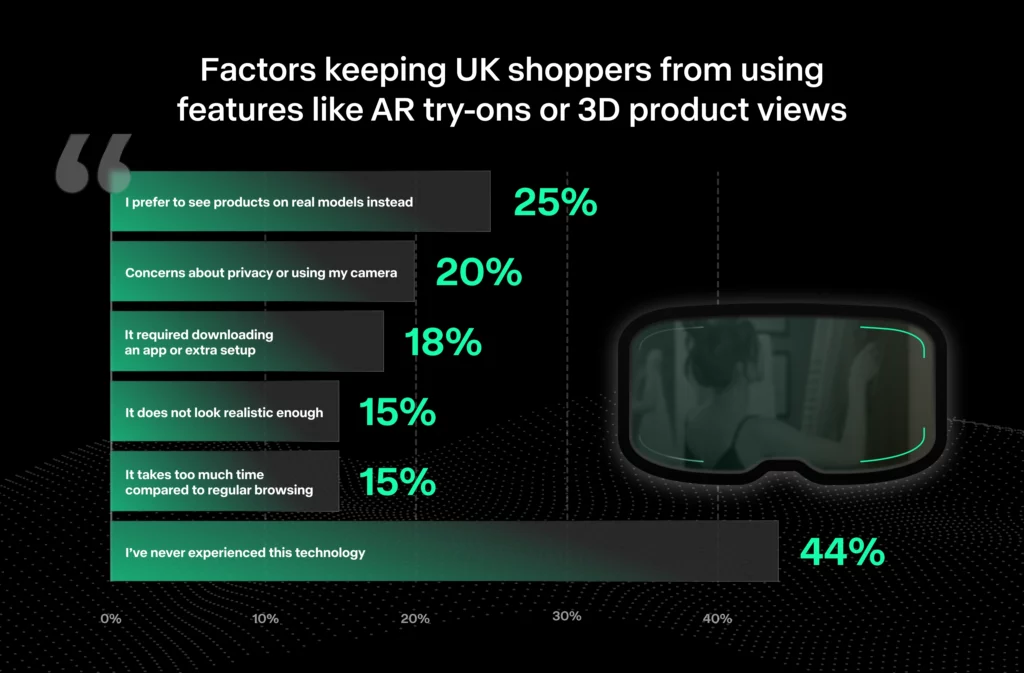
In the UK, however, these shopping features haven’t hit the mainstream, but it’s not because shoppers are rejecting them. 44% of consumers say they haven’t experienced the technology at all. And for those who have experienced it, hesitation comes from concerns around preference, and privacy – not disinterest.
But AR’s potential is clear with a third of UK shoppers saying these features would make them more likely to purchase products.
This data shows that, in the UK, AR isn’t an expectation or a must-have. It’s a conversion driver – valuable when done well, yet easy to ignore when done poorly.
For enterprise fashion retailers, the opportunity lies in early adoption. Introduce AR and 3D product views that offer clear value, minimal friction, and an opt-in approach that builds trust. The brands that start refining these experiences now will be the ones ahead of the curve when immersive shopping becomes the standard.
Quick commerce falls flat
Q-commerce (quick commerce) – ultra-fast delivery strategy born from categories like food and grocery retail – is coming to fashion.
Major UK retailer John Lewis is already trialing this feature by partnering with UberEats. It’s offering nearby customers the chance to have a selection of beauty, gifts, and electrical products delivered straight to their door in minutes.
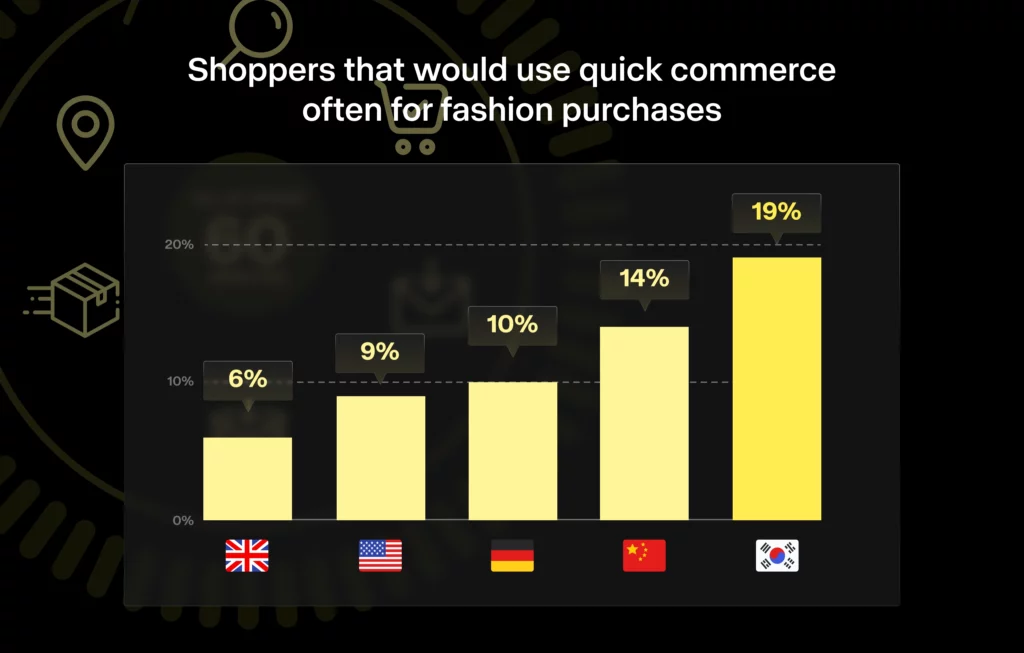
But British shoppers aren’t sold on it yet. Compared to Eastern markets, like China, where nearly 60% of shoppers say they would use q-commerce for special occasions, only 19% of British consumers said the same. As the majority remain unconvinced, it’s clear that, in this region, consumers may not equate delivery speed with real value.
Unlike other markets, immediacy doesn’t drive demand in the UK. Shoppers likely prioritize other factors, like reliability, fit, and experience over shaving days off of delivery times. For now, ultra-fast fashion fulfillment is more of a novelty than a necessity.
Winning the UK market in 2026
The UK fashion shopper is open to new technology in fashion – but only if it’s optional and offers real value.
For enterprise fashion retailers, success in 2026 won’t come from chasing every new capability. It will come from creating experiences that respect agency, build trust, and meet shoppers’ real needs.
Curious how these UK trends connect to the global fashion retail market? Download the guide, Fashion Retail 2026: Strategies for Winning in a World of AI, Algorithms, and Tariffs.