What Is Cyber Week?
What is Cyber Week?
Cyber Week refers to the five-day shopping period that begins with Thanksgiving Day and ends with Cyber Monday in the United States. It’s a major retail event, both online and offline, where businesses offer deep discounts and promotions to attract holiday shoppers.
In simple terms: Cyber Week is the biggest online shopping event of the year, designed to kick off the holiday shopping season with significant sales and deals.
What strategies can businesses use to maximize Cyber Week sales?
Businesses can maximize Cyber Week sales by offering early promotions, optimizing website speed, using targeted ads, leveraging email marketing, bundling deals, and ensuring seamless checkout. While goal is to create a purchase incentive for the user, it is also important for businesses to optimize their eCommerce platform by:
- Prepare Inventory – Ensure you have enough stock for high-demand items.
- Optimize Your Website – Ensure your site is mobile-friendly and can handle increased traffic.
- Create Irresistible Offers – Bundle deals, site-wide discounts, and flash sales.
- Leverage Email Marketing – Send out early-bird offers and reminders.
- Use Social Media Promotions – Share countdowns, sneak peeks, and exclusive deals.
- Personalized Recommendations – Use AI-driven product recommendations to increase AOV (Average Order Value).
- Offer Free Shipping – A key incentive to encourage purchases.
- Streamline Checkout Process – Make sure the checkout is fast and easy to avoid cart abandonment.

How can businesses prepare their websites and inventory for Cyber Week traffic?
Cyber Week brings a significant surge in online traffic and sales opportunities. To maximize revenue and provide a seamless customer experience, businesses must optimize their website and prepare their inventory in advance.
- Optimize Site Speed & Performance: Minify CSS, JavaScript, and HTML to reduce page load time.
- Ensure Mobile Optimization: responsive design for seamless browsing across devices.
- Strengthen Website Security: install an SSL certificate to enable HTTPS.
- Stress Test Your Website: conduct load testing to handle traffic surges
- Simplify the Checkout Process: offer guest checkout options and provide multiple payment options.
- Enhance Customer Support: install live chat support using available platforms
- SEO & Analytics Optimization: optimize product pages with Cyber Week-specific keywords.
Where should businesses advertise their Cyber Week deals for maximum reach?
Businesses should advertise Cyber Week deals on social media, Google Ads, email marketing, influencer partnerships, SMS campaigns, and their website to maximize reach and conversions.
What is the difference between Cyber Monday and Cyber Week?
Cyber Monday is a single day — the Monday immediately following Thanksgiving in the US — originally coined in 2005 to describe the spike in online shopping that occurred when people returned to work after the holiday weekend and used their office internet connections to shop. Cyber Week is the extended version: the full five-day period from Thanksgiving Thursday through Cyber Monday, and increasingly the entire week that follows.
For enterprise retailers, the distinction matters operationally. Cyber Monday was historically the peak single day for online sales, but consumer behaviour has shifted. Shoppers now spread purchases across the full week, and many retailers launch “early Cyber Week” campaigns as far back as the first week of November. The result is a multi-week demand window, not a single-day spike.
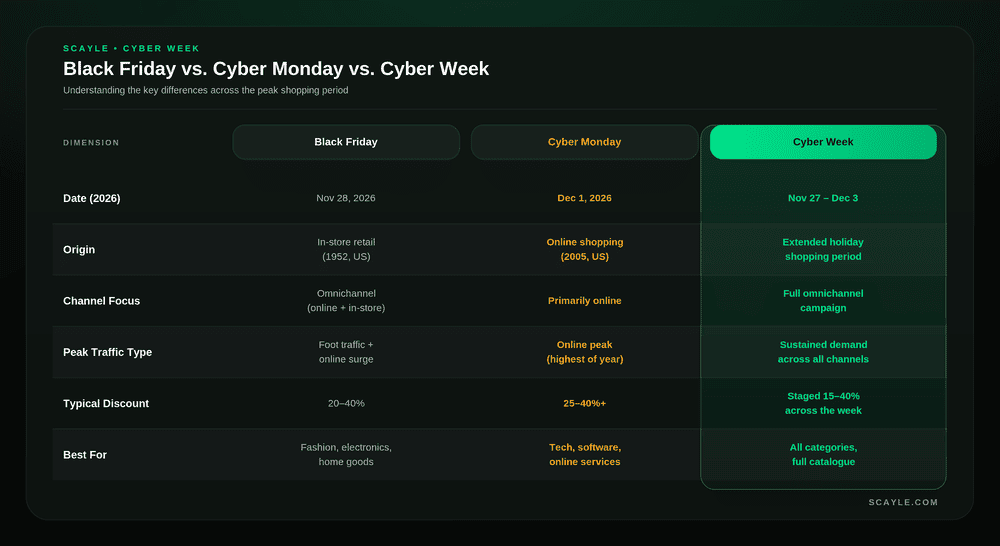
In 2026, Cyber Week runs November 27 – December 3, with Black Friday on November 28 and Cyber Monday on December 1. Planning for enterprise retailers should begin no later than September.
What are the best Cyber Week deals and discounting strategies for retailers?
The biggest mistake retailers make during Cyber Week is leading with maximum discounts from day one — which compresses margin, trains customers to wait for the lowest price, and leaves no room to escalate urgency as the week progresses. The most effective Cyber Week discounting strategies are structured, staged, and data-driven.
Proven discounting frameworks
- Descending discount model — Start with moderate discounts (15–20%) early in the week, escalate on Black Friday (25–30%), and peak on Cyber Monday (30–40%). This rewards early buyers and creates urgency without burning margin on full-week deep discounting.
- Category rotation — Rotate which categories are discounted each day to drive repeat visits. Fashion Monday, Electronics Wednesday, Home & Living Friday. Keeps the week fresh and spreads demand across the catalogue.
- Tiered spend thresholds — “Spend €100, get 15% off / Spend €150, get 20% off” increases average order value (AOV) significantly. Manage this directly via SCAYLE’s Promotions engine.
- Bundle deals — Bundle slower-moving SKUs with bestsellers at a combined discount. Clears inventory while maintaining margin on the hero product.
- Flash sales — 2–4 hour limited-time deals drive urgency and repeat site visits throughout the week. Requires real-time inventory management to avoid overselling.
- Loyalty-first access — Open deals 24–48 hours early to loyalty programme members. Reduces day-of traffic peaks and rewards your most valuable customers. Pair with personalised recommendations to increase AOV.
What not to do
- Blanket sitewide discounts from day one — Margin compression with no urgency mechanism.
- Discounting without inventory alignment — Promoting a product you can’t fulfil destroys customer trust at scale.
- Ignoring post-Cyber Week — The shopping intent window extends into the second week of December. A structured wind-down promotions calendar captures late shoppers without further margin sacrifice.
How should enterprise retailers prepare for Cyber Week traffic and demand surges?
Cyber Week is the highest-traffic, highest-stakes operational period of the retail calendar. For enterprise retailers operating at scale, preparation is a multi-month process — not a last-minute checklist.
8-week preparation timeline:
8 weeks out (September)
- Finalise promotional calendar and discount architecture
- Confirm supplier commitments and stock levels for hero SKUs via PIM
- Brief paid media, email, and content teams on campaign narrative
6 weeks out (October)
- Begin building email and SMS audience segments for early-access campaigns
- Run load tests on your storefront — simulate 3–5x your average peak traffic
- Audit checkout for friction: guest checkout, payment methods, mobile experience
4 weeks out (early November)
- Launch teaser campaigns and wishlist features to capture pre-intent signals
- Confirm order management routing rules for peak fulfilment
- Brief customer service teams on expected volume and escalation paths
2 weeks out
- Activate early-access deals for loyalty members
- Final load test and performance review of all critical pages (PDP, cart, checkout)
- Confirm delivery cut-off dates and communicate them clearly on-site
Cyber Week
- Monitor real-time analytics dashboard — traffic, conversion, AOV, and fulfilment SLAs
- Rotate daily deals and flash sale activations per calendar
- Respond to inventory depletion signals immediately — suppress out-of-stock PDPs to protect conversion rate
How can retailers protect ecommerce security during Cyber Week?
Cyber Week is not just the biggest sales period of the year — it is also the highest-risk period for ecommerce security. Fraudulent orders, credential stuffing attacks, bot-driven inventory hoarding, and phishing campaigns targeting shoppers all spike significantly in November. Enterprise retailers need a security posture that scales with traffic — without adding friction to legitimate customer journeys.
Key security risks during Cyber Week
- Card testing attacks — Fraudsters use high-volume automated transactions to test stolen card numbers. Spike in small, failed transactions is the signal. Requires fraud scoring at checkout.
- Bot-driven inventory hoarding — Automated bots add high-demand items to cart en masse, creating artificial out-of-stock signals and enabling reselling. Requires bot detection and inventory hold time limits.
- Account takeover (ATO) — Credential stuffing attacks using leaked username/password combinations to access customer accounts and loyalty balances. Multi-factor authentication and anomaly detection are the primary defences.
- Phishing and brand impersonation — Fraudulent “Cyber Week deal” emails and fake storefronts impersonating your brand. Monitor for domain spoofing and educate customers via your own channels.
- DDoS attacks — Competitors or bad actors targeting your storefront during peak traffic. Requires CDN-level DDoS protection and autoscaling infrastructure.
Security checklist for Cyber Week
- SSL/HTTPS on all pages — non-negotiable baseline
- PCI-DSS compliance verified for all payment processing
- Rate limiting on login, checkout, and cart endpoints
- Real-time fraud scoring integrated at checkout
- Bot detection (e.g. Cloudflare, reCAPTCHA Enterprise) on high-value flows
- Monitoring alerts for traffic anomalies, checkout error spikes, and unusual order patterns
Security preparation is not a standalone workstream — it must be integrated into your overall Cyber Week technical readiness plan alongside performance and availability.
Black Friday & Cyber Monday Playbook: Essential Tips for eCommerce
Everything your team needs to prepare your platform, inventory, and promotions for the biggest trading week of the year — from load testing to discount architecture.

Want to take a step into the future of eCommerce?
Download our whitepaper to delve into the hottest upcoming retail trends and learn how to leverage today’s tech to stay agile tomorrow.