What Is Dropshipping?
What is dropshipping, and how does it work?
Dropshipping is a retail fulfillment method where an online store sells products without keeping any inventory. Instead, when a customer places an order, the store purchases the product from a third-party supplier (usually a wholesaler or manufacturer), who then ships the product directly to the customer.
In simple terms: you sell the product on your online store, and a supplier handles storage, packaging, and shipping on your behalf. You act as the middleman between the customer and the supplier.
How dropshipping works:
- Set up an online store: List products from suppliers on your eCommerce platform.
- Customer places an order: A customer purchases a product from your store.
- Forward the order to supplier: You send the order details to your dropshipping supplier.
- Supplier fulfills the order: The supplier ships the product directly to your customer.
- You keep the profit margin: You earn the difference between the wholesale price and the retail price.
What are the advantages and disadvantages of a dropshipping business?
The primary advantages of dropshipping businesses include:
- Low startup costs: No need to invest in inventory or warehousing.
- Easy to start: Set up an online store quickly with a multitude of platforms
- Scalability: You can sell a wide variety of products without managing physical stock.
- Flexible location: Run your business from anywhere with an internet connection.
- Reduced overhead: No warehousing, packaging, or shipping responsibilities.
Common challenges and disadvantages of dropshipping include:
- Lower profit margins: Since suppliers handle logistics, profit margins are typically slimmer.
- Limited inventory control: Suppliers may run out of stock without notifying you.
- Shipping complexities: Shipping times may be longer, especially if sourcing from overseas suppliers.
- Quality control issues: You don’t get to inspect products before they reach customers.
- High competition: Low barrier to entry means many businesses may sell the same products.
Why is finding the right supplier crucial for dropshipping success?
The right supplier ensures product quality, reliable shipping, and competitive pricing, which are essential for customer satisfaction, brand reputation, and long-term dropshipping success.
How can businesses optimize marketing and customer service in dropshipping?
Businesses can optimize marketing with targeted ads, SEO, and social media while enhancing customer service with fast responses, clear policies, and proactive order tracking updates.
What suppliers and platforms support dropshipping?
Choosing the right supplier and platform is the most consequential decision in a dropshipping business. The supplier determines product quality, shipping speed, and margins — while the platform determines how efficiently you can manage orders, integrate suppliers, and scale.
Top dropshipping supplier directories
- AliExpress / DSers — Largest product catalogue globally, low prices, longer shipping times from China. Best for volume and variety.
- Spocket — Focused on US and EU suppliers, faster shipping times, better for brand-conscious stores.
- Syncee — 12,000+ global brands, strong European supplier network.
- Faire — Wholesale marketplace popular for independent brands and boutique retail.
- Convictional — Purpose-built for enterprise retailers integrating dropship suppliers into existing commerce infrastructure.
How the platform fits in
Your eCommerce platform sits at the centre of the dropshipping operation — managing the storefront, routing orders to suppliers, and syncing inventory. For enterprise retailers, the platform needs to handle dropship supplier integrations at scale, often alongside owned inventory in the same order management system.
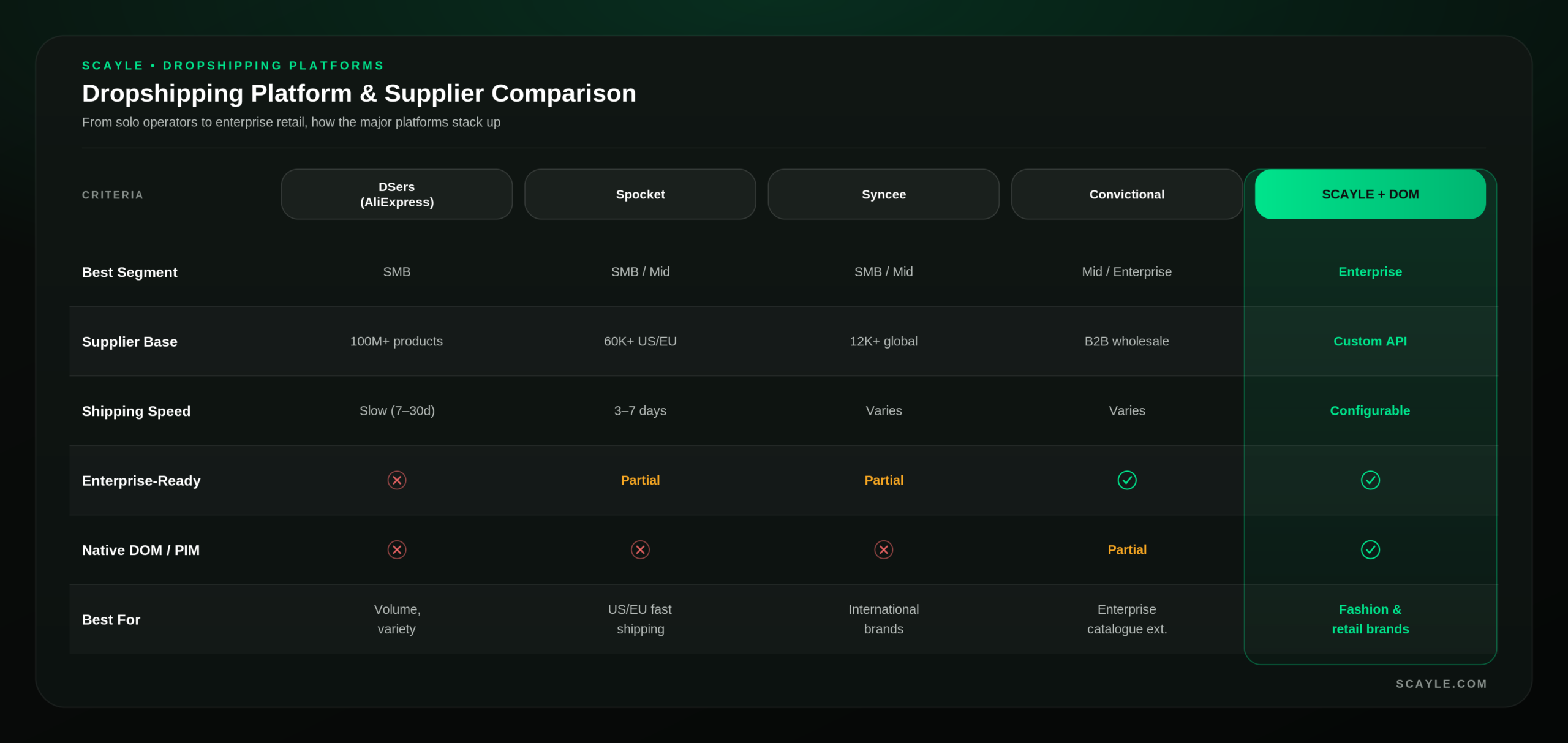
For enterprise fashion and retail brands using SCAYLE, dropshipping suppliers can be integrated via API directly into the Distributed Order Management layer — routing orders intelligently between owned stock and third-party suppliers without manual intervention.
What are the pros and cons of dropshipping for enterprise retailers?
Dropshipping looks different at enterprise scale than it does for a solo operator. The advantages and risks shift significantly once you’re running a high-volume, multi-market retail operation.
Pros at enterprise scale
- Catalogue expansion without inventory risk — Add thousands of SKUs from supplier partners without committing to stock. Particularly powerful for seasonal or trend-driven categories like fashion and home living.
- Faster market entry — Launch new product categories or test new markets without the lead time of traditional wholesale buying cycles.
- Flexible supplier redundancy — Route orders to alternative suppliers when primary stock runs out, reducing out-of-stock revenue loss.
- Reduced warehousing costs — Supplement owned fulfilment with supplier-direct shipping to reduce storage overhead, especially for bulky or slow-moving SKUs.
Cons at enterprise scale
- Brand consistency risk — Supplier-shipped orders may arrive in unbranded packaging, diluting the customer experience. Requires clear supplier agreements and quality control protocols.
- Margin compression — Supplier margins are thinner than owned inventory. High order volumes help, but pricing strategy requires careful management via promotions and bundling.
- Data fragmentation — Without proper integration, supplier inventory data and order status live outside your core system, creating blind spots. Solved by integrating suppliers into a unified analytics layer.
- Shipping complexity — Multi-supplier orders may result in split shipments with inconsistent delivery windows — a significant customer experience issue at scale.
How profitable is dropshipping, and what affects margins?
Dropshipping margins are typically lower than owned-inventory retail — but profitability depends heavily on niche, supplier relationships, order volume, and operational efficiency.
Typical margin ranges
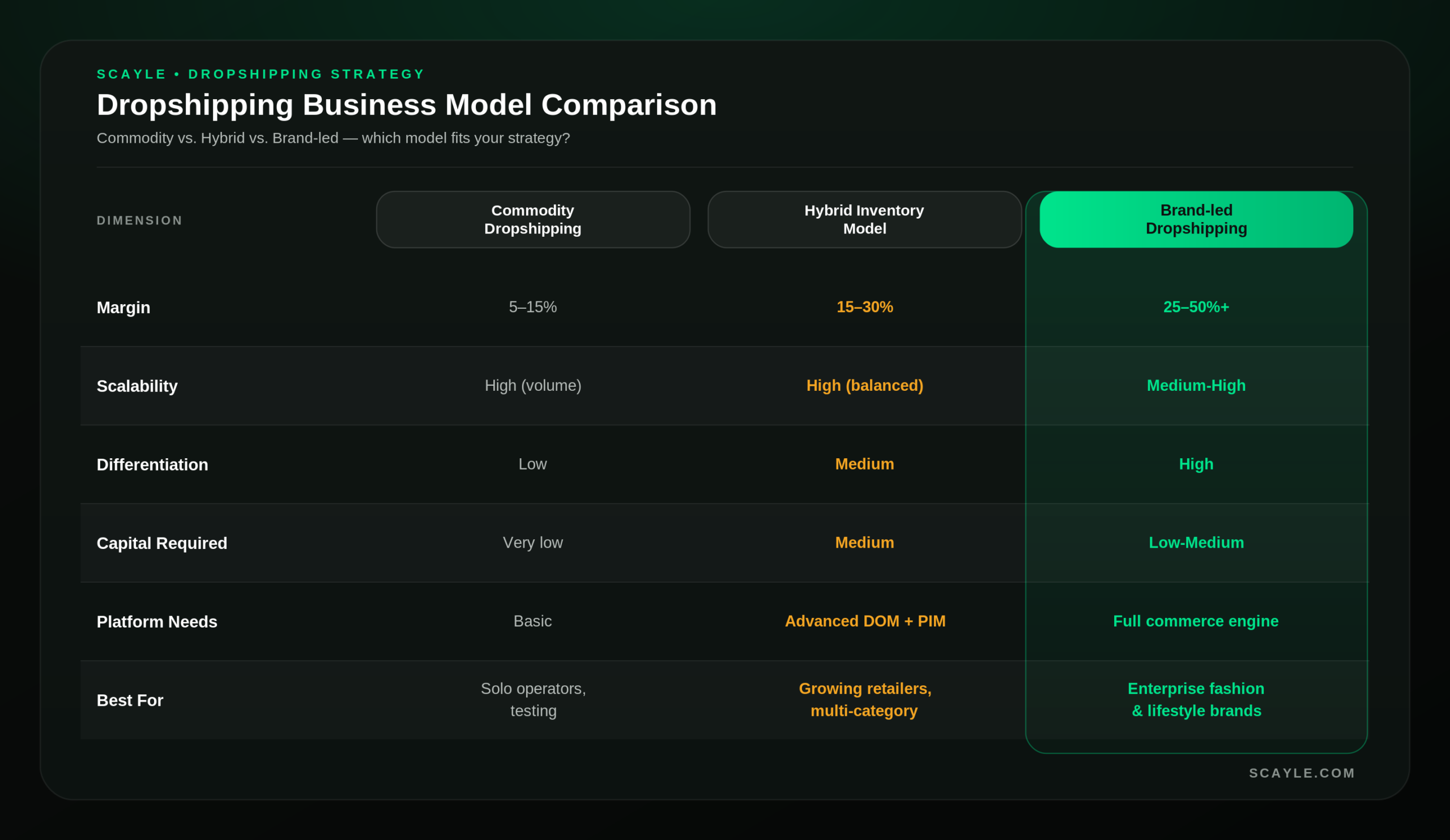
- General consumer goods: 10–20% net margin
- Fashion and apparel: 20–35% (higher perceived value, stronger brand premium potential)
- Electronics: 5–10% (high competition, price-sensitive category)
- Niche / premium products: 30–50%+ (lower competition, higher willingness to pay)
Key factors that affect dropshipping profitability
- Supplier pricing and terms — Volume discounts and exclusive supplier agreements directly protect margin. Negotiate minimum advertised price (MAP) policies where possible.
- Return rates — High return rates, common in fashion, erode margin fast. Invest in accurate product information (size guides, material specs, imagery) to reduce returns.
- Shipping costs — Free shipping expectations from consumers compress margin. Factor fulfilment costs into retail pricing from the start.
- Promotions and discounting — Frequent discounting on already-thin margins is a fast path to unprofitability. Use targeted promotions based on customer analytics rather than blanket discounts.
- Platform and payment costs — Transaction fees, platform licensing, and payment processing eat into margin on every order. Enterprise platforms with lower per-transaction costs improve unit economics at scale.
What are the best dropshipping business strategies for 2026?
The most successful dropshipping businesses in 2026 are moving away from the generic, low-margin model and toward more defensible, brand-driven approaches. The commodity dropshipping model — replicate a product from AliExpress and advertise it — is increasingly squeezed by competition and rising ad costs.
Strategies that work at scale
1. Niche specialisation over broad catalogues Dominating a specific category (e.g. sustainable sportswear, premium home textiles) builds brand authority and reduces direct price competition. Pair with SEO-optimised product content and editorial storytelling to differentiate.
2. Hybrid inventory model The most resilient approach combines owned bestseller inventory with dropship-extended catalogue. You control quality and margins on top sellers; you test and expand via dropship without capital risk. SCAYLE’s Distributed Order Management is built for exactly this hybrid model.
3. Supplier exclusivity and white-labelling Negotiating exclusive supplier agreements or white-label product arrangements creates defensible differentiation. Even in dropshipping, brand matters — generic product with your brand, sizing, and quality standards is a fundamentally different business.
4. Data-driven supplier management Use analytics to continuously evaluate supplier performance: on-time delivery rate, return rate by supplier, margin by category. Drop underperforming suppliers quickly rather than letting them erode customer satisfaction.
5. Multi-channel presence Distribute across your own storefront, marketplaces, and social commerce channels simultaneously. A unified commerce platform syncs inventory and orders across channels, preventing overselling and ensuring consistent pricing.
How do modern dropshipping platforms work?
Modern dropshipping platforms have moved far beyond simple supplier directories. Today’s enterprise-grade systems automate the full order lifecycle — from supplier inventory sync to customer-facing tracking — with minimal manual intervention.
Core capabilities of a modern dropshipping platform
- Real-time inventory sync — Supplier stock levels update automatically in your storefront, preventing overselling. Managed via Product Information Management (PIM) integrations.
- Automated order routing — When a customer places an order, the system automatically routes it to the correct supplier based on stock availability, location, and cost rules — no manual processing.
- Multi-supplier order splitting — A single customer order containing products from multiple suppliers is split and routed correctly, with consolidated tracking communicated back to the customer.
- Returns management — Return requests are routed back to the correct supplier with the appropriate restocking or refund logic applied automatically via DOM.
- Performance analytics — Supplier scorecards, margin tracking by SKU, and fulfilment SLA monitoring give operations teams the data to manage supplier relationships proactively.
For enterprise retailers, these capabilities need to sit inside a composable, API-first commerce architecture — not bolted on as a plugin. SCAYLE’s platform is built with this integration layer at its core, enabling retailers to run dropship and owned inventory in a single unified system.