What Is Enterprise Resource Planning (ERP)?
Enterprise Resource Planning (ERP) is a category of business software that unifies core operational functions — finance, inventory, supply chain, procurement, and order data — into a single system of record, instead of running them as disconnected tools. In retail, ERP typically sits behind the storefront, feeding it stock levels, order status, and financial data rather than managing the customer-facing experience itself.
ERP vs. Commerce platform
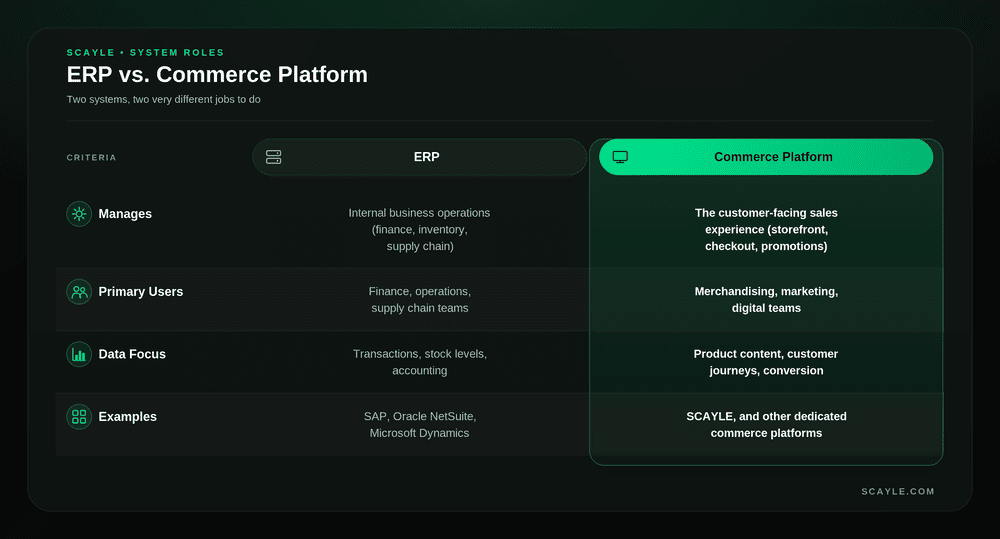
What does an ERP actually manage?
A typical retail ERP covers:
- Finance and accounting — general ledger, invoicing, tax, and financial reporting
- Procurement and supply chain — supplier orders, purchasing, and logistics coordination
- Inventory and warehouse management — stock levels, replenishment, and warehouse operations
- Order management — order status and fulfillment data across channels
- Reporting and analytics — a consolidated, business-wide view of performance
Why does ERP integration matter for eCommerce
An ERP only delivers value to a retail business if its data reaches the storefront in real time. Without clean integration, inventory counts drift out of sync (leading to overselling), order data has to be reconciled manually between systems, and finance teams end up rebuilding reports by hand. This is why ERP integration is rarely a “set it and forget it” project — it requires an API layer, or a commerce platform built to connect cleanly with ERP systems, to keep data consistent as order volume and channel count grow.
What are the advantages and challenges of running an ERP?
Advantages:
- One source of truth — finance, inventory, and operations all work from the same data
- Fewer manual errors — less spreadsheet reconciliation between departments
- Better forecasting — unified data makes demand planning and purchasing more accurate
- Audit-ready compliance — centralized financial records simplify reporting and audits
Challenges:
- High implementation cost and time — enterprise ERP rollouts commonly take months to years
- Rigidity — ERPs are built for broad operational coverage, not for fast-moving storefront features
- Integration complexity — connecting an ERP to a modern, composable commerce stack takes deliberate architecture, not a plug-and-play link
- Change management — teams across finance, ops, and digital all need to adapt workflows around the same system
When should a retailer invest in tighter ERP-commerce integration?
The need becomes urgent once a retailer is selling across multiple channels or warehouses, processing high order volumes, or managing multi-entity/multi-country finance — the points at which manual reconciliation between ERP and storefront data stops being a minor annoyance and starts causing real errors: overselling, delayed orders, and inaccurate financial reporting.

See what happens when backend complexity gets out of the way
Kapten & Son’s team spent years fighting a fragmented backend before integrating their order management system into a unified, composable platform