
Key Takeaways
- Fashion shopping starts with inspiration, not a search term, shoppers browse first and decide what they want along the way, especially on mobile.
- Uncertainty drives returns, not browsing itself, when shoppers aren’t sure about fit, color, or material, they order multiple options “just in case.”
- Every return is product feedback, reasons like “too small” or “not as expected” reveal real gaps in product pages, and those gaps can cost retailers the customer entirely.
-
Fixing returns means connecting the dots, product data, fit guidance, and return analytics need to work together so retailers solve the root cause instead of repeating it every season.
A shopper opens a fashion app to check one new drop. Ten minutes later, they saved a jacket, compared three pairs of sneakers, and added a dress they did not know they wanted. A spontaneous purchase does not automatically become a return. The risk appears when inspiration moves faster than product confidence. And that changes what your commerce technology needs to do.
Fashion demand is created during discovery
Few apparel shoppers begin with a specification such as “black midi dress, square neckline, size 8.” They begin with a wedding, a weather change, a creator’s outfit, or simply the feeling that their closet could use something new.
That makes fashion shopping closer to entertainment than an errand. 67% of consumers have made a purchase while doing something else, such as scrolling social media or watching a show. Mobile makes those moments easy to act on. Adobe Analytics reported that smartphones generated 60.8% of US online apparel sales in July 2024.
Fashion retailers therefore need storefronts that move shoppers from vague inspiration to a confident choice. Think visual navigation, curated edits, complete-the-look suggestions, useful filters, and recommendations that respond to behavior rather than one isolated search term.
The goal is not to force every shopper down the shortest route to checkout, but to make exploration effortless without leaving them guessing about what they are buying.
Browsing doesn’t create returns, uncertainty does
Fashion creates more questions than one image can answer. Will the color look the same in daylight? Does the fabric have structure or stretch? Is this brand’s medium actually a medium?
The difference between online and in-store returns shows how much those questions matter. Shoppers return items bought online far more often than those bought in a physical store: the online return rate sits at 24.5%, while merchandise purchased in-store comes back at just 8.72%.
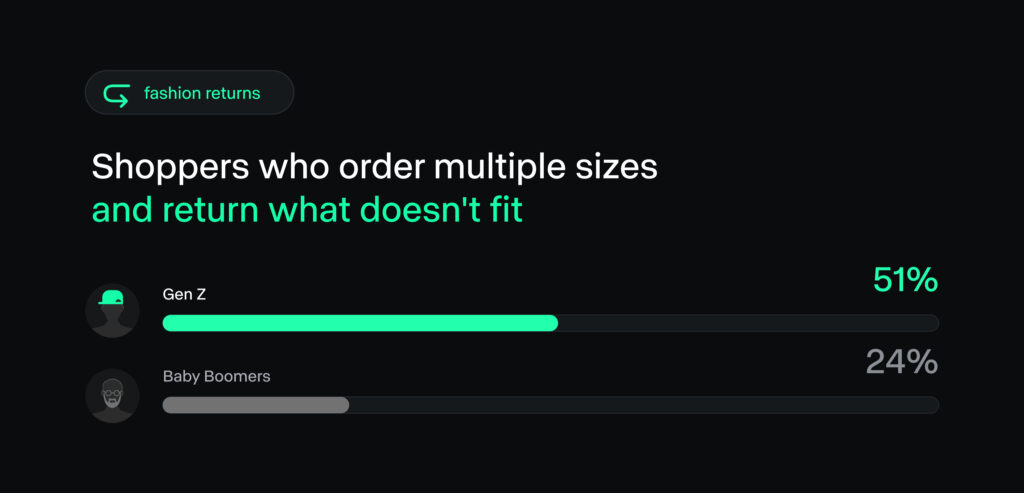
That behavior is often called bracketing, and it is rational from the shopper’s perspective: when sizing is uncertain, ordering several options feels safer than ordering just one. Gen Z drives this trend hardest, averaging 7.7 online returns over the past year, more than any other generation.
Retailers can tighten return policies, but that treats the symptom. So what information was missing when the shopper made the decision?
Every return is product feedback
A return reason is not just a logistics code. It is a clue.
“Too small” may point to inconsistent sizing or an inaccurate size recommendation. “Not as expected” may indicate that the photography hid the garment’s texture, color, or shape. “Poor quality” can reveal a gap between the product description and what arrived.
Those gaps are expensive, and they do not stop at the return label. In the last year, 87% of US shoppers abandoned a brand, and product quality was the leading reason across every generation. When what arrives fails to match what the page promised, shoppers often do not come back.
Strong fashion product pages reduce uncertainty before checkout. They show multiple angles, movement, close-up fabric details, accurate color, model measurements, garment dimensions, fit notes, material composition, and care instructions. Reviews become more useful when shoppers can filter them by size, body type, or comments such as “runs small.”
Virtual try-ons and fit technology should not exist as shiny add-ons disconnected from the catalog. They need structured product data, reliable size information, and a platform that can integrate new experiences as the technology improves.
What fashion-native commerce technology does differently
Fashion does not just have more SKUs. It has more relationships between them.
A single style may include several colors, sizes, lengths, fits, images, prices, regional descriptions, and availability rules. A multi-brand retailer must also translate hundreds of sizing systems into one understandable experience. New drops arrive quickly. Fashion trends move faster. Campaign content changes by market, season, and channel.
Fashion-native technology treats this complexity as the operating model, not an exception. It connects rich product and variant data to the storefront, so shoppers see accurate information wherever they browse. It supports editorial collections, outfit links, visual discovery, and mobile-first experiences without turning every update into a development project.
It also connects return reasons and analytics to individual products and variants, helping teams identify whether one size, color, image set, or description is creating avoidable returns.
When merchandising, product content, fit guidance, and return analytics work together, retailers can fix the source of a problem instead of processing the same return again next season.
Turn browsing into an advantage
Search tells you what shoppers can put into words. Browsing shows you what catches their eye.
Every product view, swipe, save, comparison, and abandoned cart adds context. Used thoughtfully, those signals can improve product ranking, recommendations, campaign curation, and complete-the-look suggestions. They can reveal style affinities that a keyword never would.
The stronger approach combines inspiration with control: recognizable categories, intuitive filters, relevant recommendations, and enough visual storytelling to invite one more scroll.
Fashion shoppers will continue to browse for fun. Good! That is where desire begins.
The challenge is whether your platform can turn that desire into a decision the shopper still feels good about when the parcel arrives. Retailers that close the gap between inspiration and confidence will not only reduce avoidable returns. They will learn faster from every browse, purchase, and return.
Ready to build for the way fashion really shops?