
Key Takeaways
- Context beats compute: Fashion AI struggles with style, intent, and brand fit, not processing power.
- Intent over signals: Knowing why a shopper bought matters more than knowing what she bought.
- Specialized wins: 67% of leaders who compared rate fashion-specific AI above generic tools.
- Connected data first: Linked product, customer, and inventory data let AI see the full picture.
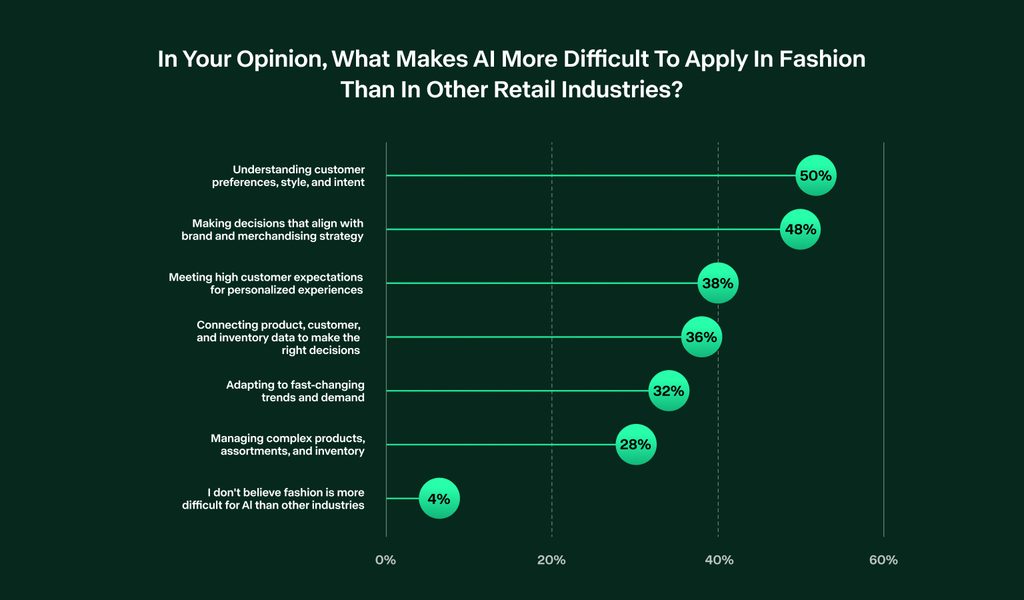
AI can make the right technical decision. But can it make the right commercial one? That question sits at the heart of AI for fashion. In our survey across senior fashion executives, 50% of respondents named understanding customer preferences, style, and intent as the biggest challenge of applying AI in the industry. Because a tool that understands retail doesn’t automatically understand fashion.
What makes AI harder to apply to fashion?
We asked enterprise fashion leaders what makes applying AI in fashion more difficult than in other retail industries. Half pointed to understanding customer preferences, style, and intent. Another 48% named making decisions that align with brand and merchandising strategy.
Source: SCAYLE, Inside the Boardroom: Fashion Leaders on the Agentic AI Era (2026)
Notice the pattern? None of these challenges are about raw computing power. They’re about context. For example, when it comes to brand and merchandising strategies, a generic tool might push whatever converts best today. But a fashion brand needs more. It needs recommendations that also fit its positioning and merchandising strategy, season after season.
The right answer in fashion changes with every season, every market, and every shopper. The challenge is making AI useful in an industry where the right decision keeps moving and depends on highly specific criteria.
One black dress, two very different answers
Picture a shopper who buys a black dress. A generic AI tool knows exactly that – she bought a black dress. Cue the recommendation for more black dresses that can’t tell whether she bought it for a wedding, a job interview, or as a gift. Yet intent decides what she should see next.
A fashion-specific tool understands far more:
- Why she bought it
- Which styles she tends to buy
- What fits her
- Which products complement it
- What’s currently trending
- What’s in stock
That’s the difference between spotting a signal and understanding a situation. Fashion-specific AI maps the relationships between products, customers, and markets instead of treating each signal in isolation.
Zalando shows how much depends on that context. Its search extracts attributes from each query, so “Black Party Dress” becomes category, occasion, and color, and uses them to filter the catalog. When the team tested search quality before opening new markets, it found that missing or wrong product attributes can make items harder to find. To close such gaps at scale, Zalando built an AI copilot that suggests attributes from product images for content teams to review, and it enriched around 50,000 attributes per week in the early rollout. The more precisely the data describes each item, the better AI can match it to what a shopper means.
Want more data from our enterprise fashion retailer survey? Read the full report.
Fashion leaders already draw the line
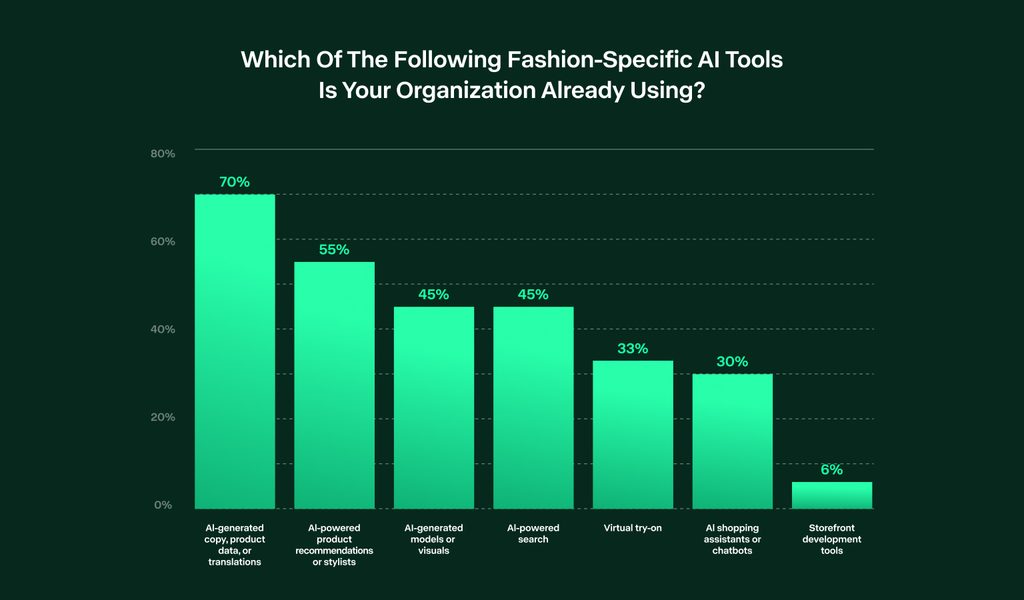
Fashion leaders increasingly separate AI that performs a task from AI that understands how that task applies to fashion. In our survey, 66% of respondents either already use fashion-specific AI or are currently testing tools in pilots.
What does that look like in practice? Among those already using it, most use cases sit close to content and discovery – where fashion context shows up fastest.
Source: SCAYLE, Inside the Boardroom: Fashion Leaders on the Agentic AI Era (2026)
The results can be big. In an A/B test at ABOUT YOU, AI-generated images achieved 9.2% higher GMV than classic studio production. And brands already put fashion-specific AI in front of shoppers: Zalando’s assistant gives personalized fashion advice to logged-in customers in all 25 of its markets, and for Ralph Lauren, Ask Ralph turns open-ended prompts into tailored looks that shoppers can add to their cart or buy head-to-toe.
Does fashion-specific AI perform better?
Of the leaders who compared the fashion-specific AI to general purpose AI 67% rate fashion-specific AI as better.
Generic AI can still deliver value, especially for routine tasks. But commercial decisions, like what to recommend, what to stock, and how to merchandise depend on fashion context. As AI takes on higher-value decisions across personalization, forecasting, and merchandising, that context will drive their quality. Every wrong guess leaves revenue on the table: a mismatched recommendation on a product page loses a sale, and a missed forecast leaves demand unserved for a whole season.
AI also needs a strong foundation: connected product, customer, and inventory data. Back to the black dress: if her purchase history, fit data, and stock levels sit in separate systems that don’t share data, AI sees each signal in isolation and can’t relate one to another. Connected data gives it one live view across all three, so every recommendation reflects the shopper, the product, and the stock at the same moment. That’s why replatforming in fashion often comes first, and why a tech stack prepared for agentic AI keeps that data accessible.
Does your AI have fashion sense?
AI with fashion sense will make fashion’s best commercial decisions. In fashion commerce, more of those decisions move to AI every year, and fashion context decides how good they are: recommendations that fit the shopper, assortments that follow demand, and choices that stay true to the brand. Brands that connect that context first can hand their AI real responsibility with confidence. Fashion has always rewarded those who understand it, and now that includes the AI they put to work.
Ready to see how enterprise fashion puts fashion-specific AI to the test?