
Key Takeaways
- Fashion discovery now happens everywhere, on the street, on social, on resale apps, in AI chats, and brands that show up first win the customer, not just the ones with the better product.
- Channel behavior varies sharply by market, one global playbook no longer works for DACH, UK, or US shoppers.
-
Secondhand and social feeds are becoming primary discovery layers, not just fallback or awareness channels.
-
AI-ready product data now determines visibility, if agents can’t parse your catalog, you don’t exist in that conversation.
A jacket on a stranger in the subway. A fit check on TikTok. A window display spotted on a lunch break. Fashion is one of the few retail categories people encounter all day, every day. And every one of those run-ins can spark the same thought: Where do I find that?
For shoppers, that moment feels effortless. For brands, it’s where things get complicated.
The ultimate omnichannel challenge
The look that triggers intent is often not your product. It’s a vibe someone spotted in the wild, and now they want it, or something close enough. That moment of intent is where brands compete.
Whoever shows up first captures that intent: in a visual search result, a marketplace listing, a social feed, an AI answer. If your products aren’t discoverable in that moment, you’re not losing to a better competitor. You’re losing to a more findable one.
Even deliberate searches start all over the place
Sometimes discovery is less accidental. The shopper knows they need a new coat and starts looking. Where? That depends massively.
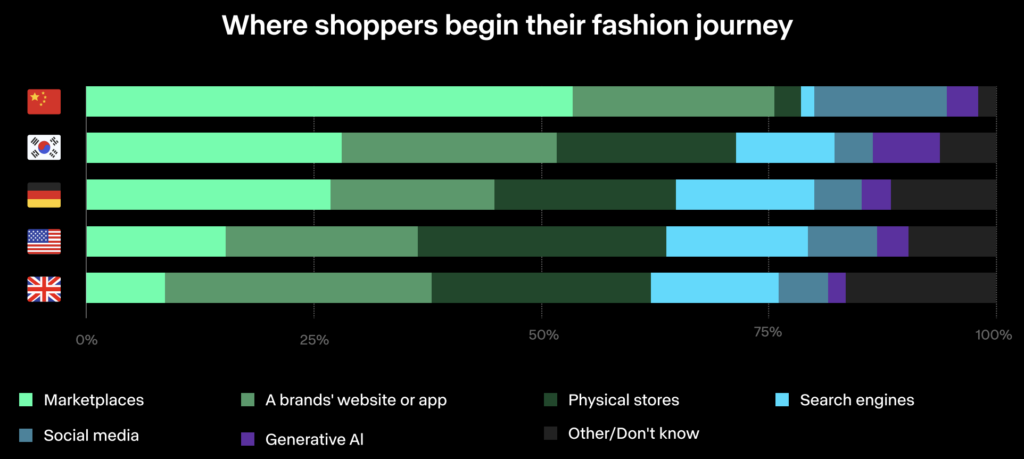
Globally, 27% of shoppers start their fashion journey on online marketplaces, 23% on brands’ websites or apps, and just 7% on social media. Sounds like social barely matters? Just because a consumer doesn’t start on a channel, doesn’t mean they don’t end up there. 26% of shoppers bought via TikTok Shop in 2025 alone. Not to mention how influential socials are for triggering intent in the first place.
The global averages hide even bigger differences between markets. Shoppers in the DACH region head straight for marketplaces. The UK remains a brand-first market for fashion shopping. And in the US, apparel shopping still begins in physical stores. One playbook for all of them won’t cut it.
Want to know which trends will shape where shoppers start their journey next? Read 4 Fashion Industry Trends Taking Off in 2026.
Discovery keeps fragmenting
Just as brands adapt to this channel mix, two more discovery layers are gaining ground fast.
Secondhand comes first
For millions of shoppers, consumer-to-consumer platforms like Depop are the first stop, not the fallback. The global secondhand apparel market has reached $393 billion, roughly 10% of total apparel spend, according to ThredUp’s 2026 Resale Report. In the US, secondhand grew nearly four times faster than the broader clothing market in 2025.
Nearly half of shoppers now discover their next secondhand find through social feeds and creators instead of traditional search. Discovery and sustainable shopping increasingly happen in the same scroll.
AI agents enter the journey
The newest discovery layer doesn’t scroll at all. It chats. Shopping-related searches on generative AI platforms grew 4,700% between 2024 and 2025, and 23% of consumers already use generative AI as their primary way to discover products, according to McKinsey’s State of Fashion 2026. The same report found the trend was taking off in the fashion category citing that ChatGPT accounted for 16% of Zara’s and 8% of H&M and Aritzia’s inbound referral traffic between June and August 2025.
Shoppers ask LLMs to compare products and recommend outfits. Agentic platforms like Daydream take it further and act on the shopper’s behalf. The real challenge is that AI models only surface products with semantically rich, machine-readable data. If an agent can’t parse your catalog, you don’t exist in that conversation.
What this means for the customer journey
The classic funnel assumed shoppers enter at the top and move politely toward checkout. Real fashion journeys rarely follow that path. They start mid-inspiration, jump between channels, and end wherever buying is easiest.
That changes three things. Shoppers search for vibes, not keywords (“the jeans from that one TikTok”). Your product data now needs to convince humans and machines alike. And every channel can be the entry point and the point of sale at once.
Why a fashion-native tech stack wins
Most generic commerce platforms are built search-led. They assume shoppers arrive knowing what they want, type it into a search bar, and filter their way to checkout. Fashion discovery often works the other way around: inspiration comes first, and the product follows.
A fashion-native platform is built for that reality. In practice, being discovery-ready means building capabilities around five areas:
-
Visual and semantic search: Shoppers find products through image similarity, style, and intent. “Something like this, but in green” becomes a query your store can actually answer.
- Outfit linking: Products connect into complete, shoppable looks. The inspiration that started the journey turns into a bigger basket instead of a dead end.
- Native marketplace and channel integrations: Product data, stock, and prices sync to new discovery channels in a few clicks. Reaching shoppers where they already browse stops being a six-month IT project.
- Structured, AI-ready product data: Clean, semantically rich attributes are what LLMs and shopping agents actually read. They decide whether your catalog shows up in an AI answer or stays invisible.
-
Composable, API-first architecture: Whichever discovery channel emerges next, it connects through APIs instead of forcing a replatforming.
None of this controls where discovery happens. But it decides whether your brand is ready when it happens: on TikTok, on a resale app, or inside an AI chat.
Curious how visual search, outfit linking, and AI-ready product data work in practice? Explore SCAYLE’s fashion commerce capabilities.
Where will your next customer find you?
Where did your last customer first see the product they bought? On your site? On a creator’s feed? In an AI chat you’ll never get analytics for? Most retailers can’t answer that question.
Discovery will keep fragmenting: into resale feeds, AI agents, and channels that don’t even exist yet. You don’t get to choose where the next journey begins. You can control whether your brand shows up when it does. That choice is an architecture decision, and it’s due now, not when the next channel takes off.
Want the full data on how shoppers discover fashion in 2026 – by market, age, and channel?