
Key Takeaways
- Discovery over checkout: Ads and customer acquisition beat the operational complexity of handling transactions.
- Ads evolve with AI: Formats like Direct Offers bring paid visibility straight into conversational AI Mode.
- Attributes beat keywords: Rich, clean product data ensures AI models can accurately find and match your products.
- Differentiate to own: Strong storefront experiences keep shoppers loyal instead of just renting them through ads.
Google AI commerce sounds like a takeover: one assistant that finds, compares, and buys for your customers. The earnings tell a different story – Google made $81.6 billion from advertising in Q2 2026 alone. That’s roughly two-thirds of Alphabet’s $119.8 billion revenue. So when Google reshapes AI shopping, ask one question first: who pays?
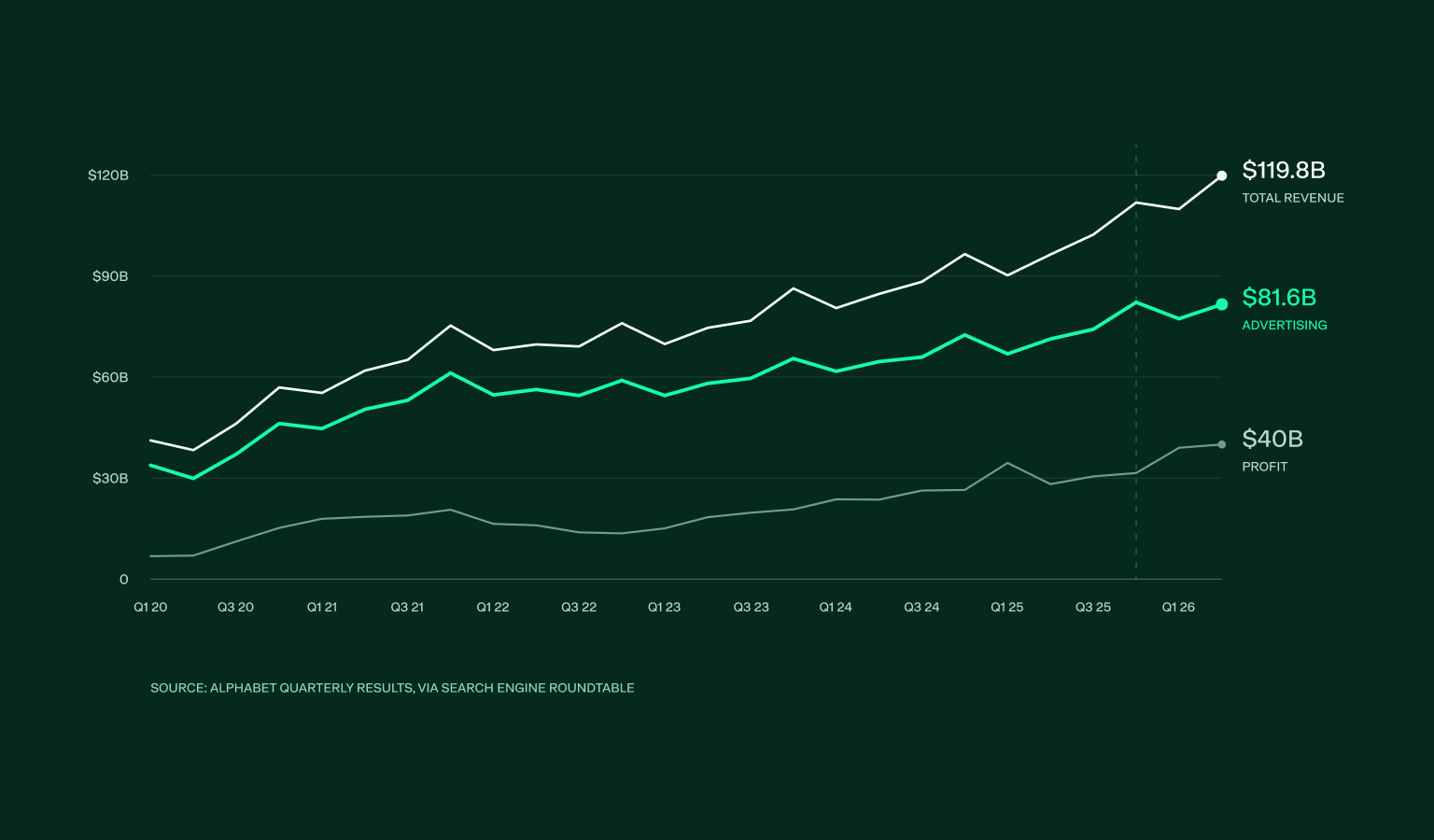
Source: Search Engine Roundtable, Google Ad Revenue Q2 2026
AI changes discovery, not ownership
Google’s AI Mode and Gemini already help shoppers research, compare, and decide what to buy. But so far, Google’s focus remains on these early stages of the shopping journey.
In January 2026, Google launched the Universal Commerce Protocol (UCP), an open standard for AI agents in commerce. Its checkout feature starts with eligible American retailers. Its ads pilot, Direct Offers, arrived in the same announcement.
That makes sense. Discovery is where AI adds considerable value: shoppers describe what they want, and AI narrows the field. Checkout demands payments, trust, and logistics – creating more complexities for retailers to navigate.
Follow the ad revenue
Google Search and other advertising grew 17% to $63.3 billion in Q2 2026, even as AI Overviews and AI Mode expanded. On Alphabet’s earnings call, the company said retail and finance drove the largest contributions.
Now look at the formats built for AI. Direct Offers lets advertisers show exclusive deals, like 20% off, to shoppers who are ready to buy in AI Mode. Advertisers set up the offers in their campaigns, Google’s AI decides when an offer is relevant, and the placement carries a sponsored label. For retailers, that means a new place to buy visibility, directly in AI Mode.
Vidhya Srinivasan, VP and GM of Ads and Commerce at Google, told CNBC that Google’s “role in the [retail] ecosystem is that of a matchmaker.” One way to play matchmaker is through ads.
Why ads beat owning the transaction
The reason is simple: economics. Selling customer acquisition through ads is a more attractive business than owning the transaction.
Consider what owning the transaction involves. Payments. Fulfillment. Customer service. Returns. In the US, 19.3% of online sales were returned in 2025 – and the retailer carries that cost. Ads carry none of it. Google earns when a shopper shows intent and an advertiser pays to meet it. The retailer keeps the inventory, the returns, and the relationship. And Google already runs that business at a massive scale.
That doesn’t mean Google ignores checkout. It means checkout and ads work together: the shopper discovers, the ad converts, the retailer delivers. This is where fashion retailers have an advantage. Only you know your assortment, your sizing data, and your brand story. And AI’s answers are only as good as the product data behind them.
Want to see AI capabilities built to keep enterprise fashion brands agile in the AI era? Explore SCAYLE Retail AI.
4 steps to prepare your fashion brand for google AI commerce
Google AI shopping will reward retailers who prepare for both paths. AI in eCommerce moves fast, so these four steps give you a clear order of work:
- Strengthen your product data. AI systems match shoppers to products using attributes, not just keywords. Rich, clean data decides who appears, so optimize attributes like fit, material, occasion, and style.
- Build content and brand visibility. AI answers draw on what shoppers and brands publish. Publish guides, size advice, and styling content that explains and differentiates your products. Then track how fashion discovery now spans every moment.
- Own your customer experience. When Google owns the first step, your storefront needs to give shoppers a reason to visit: curated campaigns, relevant recommendations, and experiences they can’t get anywhere else. SCAYLE’s AI for differentiation helps you turn your storefront into a destination with AI-generated model imagery, faster campaign launches, and online fitting rooms.
- Rethink paid acquisition. Expect more paid placements inside AI answers. Set margin floors before you test formats like Direct Offers, and track AI surfaces separately from classic search. Then compare what each budget buys: a click, a sale, or a customer you keep.
As part of the Zalando Group, a UCP member, SCAYLE helps you sell on leading AI platforms while you stay in control of fulfillment and brand experience.
Who owns your customer in 2027?
AI may change how shoppers find you. It doesn’t have to change who owns the relationship. If Google’s AI answered every fashion question tomorrow, would shoppers know your brand, trust your data, and want to visit your storefront? If not, you’re simply renting your customers from whoever sells the ad. Owning the relationship means owning the data, the content, and the experience that brings shoppers back.
Ready to keep your brand discoverable and in control? Learn more about SCAYLE’s AI capabilities for enterprise fashion.